Showing posts with label book review. Show all posts

Tuesday, January 9, 2018

A few thoughts on the book Tinkering: Australians reinvent DIY culture by Katherine Wilson

Tinkering: Australians Reinvent DIY CultureTinkering: Australians Reinvent DIY Culture by Katherine Wilson
My rating: 4 of 5 stars

This book explores the concept of tinkering in Australia. It is based on interviews with several tinkerers (mainly from Victoria) and uses aspects of ethnography as the methodology for this research. This interesting book is based on the doctoral research by the author.

There are useful ideas in this book for libraries which have maker spaces or other connections to makers and tinkerers to consider however, libraries are almost invisible in the work. There could be another interesting research project looking at the connection between libraries and making and tinkering.

The discussion of tinkering in this book includes a wide range of formats including electronics, mechanical, building, research, photography, and jam making. Mending is raised as a tinkering area, but it is acknowledged that more research needs to be done into this area.

There are useful perspectives of failure and mistakes presented through this work. Block, one of the people interviewed for the research states, ‘I make mistakes all the time, that’s how you learn about things and get more experienced. You have to think, and you have to be patient’. Hondo, another interviewee states that you ‘never know if what you imagine will turn out’.

The author writes that when ‘policy makers and bureaucrats make decisions about cultural spaces like Men’s Sheds, Hackerspaces, community gardens, manual education and innovation programs, they need to understand that their magic force lives in quests, stories, senses, skills and the plotting of self in he continuity of experience...For all its senseless and supernatural overtones, magic is an important way to understand the everyday transformative, spellbinding power that pulses through Australia’s sheds, paddocks, kitchens, backyards and workshops’. p83. This idea of forces of magic is an interesting description to use.

While there is no index, there is a useful and detailed list of select references.

View all my reviews

Tuesday, November 1, 2016

A few thoughts about How the world changed social media by by Daniel Miller, Elisabetta Costa, Nell Haynes, Tom McDonald, Razvan Nicolescu, Jolynna Sinanan, Juliano Spyer, Shriram Venkatraman , and Xinyuan Wang

How the World Changed Social Media
How the World Changed Social Media by Daniel Miller,

My rating: 5 of 5 stars

This is a very interesting read. It is part of an eleven book series which describe comparative, qualitative, anthropological field work in nine sites around the world. It was done by different anthropologists, who worked together, and did their research at the same time (except for one researcher) so information was comparative. The researchers spent time together for planning and part way through their field work, but researched in different areas around the world.

This volume brings together a summary of the different sites which are described in their separate volumes. This is really interesting because it looks at poly media (people using multiple social medias) and brings in the idea of scalable sociability. It is really interesting for the big picture trends, and differences between the sites. While I may not read all the titles in the series, I am going to read some of other books. The titles are available as free PDFs so that those who participated in the research would be able to read the findings. This is important in reporting back to those who were part of the research. The books are also available as ebooks and in print.

I think this would be interesting reading for people interested in social media or ethnography as a research methodology.


View all my reviews

Tuesday, September 20, 2016

A few thoughts in Mining the home movie: Excavations in histories and memories

Mining the Home Movie: Excavations in Histories and MemoriesMining the Home Movie: Excavations in Histories and Memories by Karen L. Ishizuka
My rating: 4 of 5 stars

I read this book as I am thinking about the importance of home movies in local studies collections. This book is not about public libraries, but about national and regional collections of film, some of which include home movies. The chapters describe the research potential of ordinary film. Some has value because of who is in it, someone famous, people interned, and in many cases, people now dead. Often the value is in the ordinariness of what is filmed, such as scone making at a fair. As an aside I hope there is film over time of scone making in Australia, I will have to track that down.

This is a book looking at film, and some times video. There is no coverage of collecting digital material. This seems a gap, although is may be because little is collected, but that is speculation. There is also little discussion about digitisation.

There are some very impressive collections, and some which often seem to record oral histories to better describe the film being collected. The Imperial War Museum, is one of those organisations.

The Florida Moving Image Archive highlights the research value from film with changes in communities, national parks and skylines all being clear. The chapter on this archive highlights the tourism and migration potential of film, as people would travel to Florida for holidays, or to live there, after having seems someone's home movie. They have an active public access program combing bus tours and viewing of local home movies.

Other experiences such as internment were illegally filmed record is key for documenting this time in the USA, as are the films of labour disputes in New Zealand.

There is considerable discussion in some chapters about the need for more representation in minority voices, which seems to include women, as not many women are credited with filming, although there are exceptions such as Mussarath Khan and Leela Anjanappa, both from India.

The North West Film Archive in England, was set up to collect film about daily life. It highlights the importance to regional and local history. They are working at developing audiences of their films showing them in places such as shopping centres, hospitals and remand centres.

I am only providing a few examples from this very interesting book. I still need to track down how digital material is being collected by these and other organisations, so that recent content will be collected and preserved. Otherwise it will be like early film which has been poorly stored and will. It will not be viewable for the future.

View all my reviews

Tuesday, September 6, 2016

Some thoughts on Archives alive: expanding engagement with public library archives and special collections by Diantha Dow Schull

Archives Alive: Expanding Engagement with Public Library Archives and Special CollectionsArchives Alive: Expanding Engagement with Public Library Archives and Special Collections by Diantha Dow Schull
My rating: 5 of 5 stars

This is an impressive look at special collections in public libraries in the USA, and much of it relates to local studies collections. This books looks at how different public libraries connect their special collections with their community, highlighting that one of the key reasons for public libraries collecting material is to make it available for their community.

The chapters explore different topics such as art and archives, community archives, exhibitions and related programs, and interactive archives. Within each chapter are several good practice examples showing how it is possible to connect communities with special collections. Each example is given with a overview, challenges and future plans, so while this is an optimistic book, the tough information is also made available.

As well as showing impressive heritage collections there are some exciting examples of libraries collecting recent content about local events including disasters such as hurricanes, floods and fires.

There are several very good examples showing how libraries have collected recent content to fill historical collections gaps, for example interviews with Spanish speaking residents in areas where there has been a long history of them living, but they were not visible in the local studies collection. Another library traced the families of Japanese residents who had been interred in World War II, as a way to better reflect the whole community. There are some lovely oral history projects recording diverse experiences of neighbourhoods.

Different kinds of programs to expose the collections were described, such as talks (often filmed), demonstrating and filming dance with the performances then becoming part of the collection, and connecting artists of all sorts to special collections for different ways of interpreting and being inspired by their content.

This is a very exciting book with many impressive examples to explore online.

View all my reviews

Tuesday, August 30, 2016

A few thoughts about Greek cafes and milk bars of Australia by Effy Alexakis and Leonard Janiszewski

Greek cafes and milk bars of AustraliaGreek cafes and milk bars of Australia by Effy Alexakis
My rating: 5 of 5 stars

This is a lovely book (and I can't believe it was not already on Goodreads).

This detailed study of Greek cafes and milk bars, in Australia, looks at both the big picture of their history, but also in the detail, the individual stories of the cafes and milk bars. Through a mix of oral history, old and new photographs, a wonderful, complex story is told. It is joyful, sad, nostalgic and modern. This is a book to keep dipping into as each person and each cafe is explored.

This would be an excellent addition to many local studies collections across Australia as the cafes and milk bars and the people who ran them or who run them are featured. I was able to read about several Greek cafes I know, from where I grew up, but also places I have visited.

This is an excellent local studies book. One minor comment, it would have been helpful to have an index entry for all the towns mentioned, the cafes and people are searchable in the index, but not the towns. Perhaps this addition could be considered for a second edition.

View all my reviews

Wednesday, August 3, 2016

some thoughts about Digital vs Human: how we'll live, love, and think in the future by Richard Watson

Digital vs Human: how we'll live, love, and think in the futureDigital vs Human: how we'll live, love, and think in the future by Richard Watson
My rating: 4 of 5 stars

This is a book to read slowly, and then to start reading again. It is a bringing together of many ideas about how people live, and challenging us about how we think about technology. It is speculative based on evidence, and is an enjoyable, and thought provoking read.

View all my reviews

Monday, August 1, 2016

a few thoughts on The book of haps

The Book of HapsThe Book of Haps by Kate Davies
My rating: 5 of 5 stars

I had not heard about haps until I found out about this book. I am glad that I came across this as it is a lovely exploration of a very specific part of the history of knitting, and of knitting in a specific local area. This would be a great book for a Shetland public library local studies collection, and for other libraries to consider for their knitting collections.

It is exciting the way this book combines the history with new designs, based on the history. The focus on the purpose of haps, and their heritage has led to some very exciting designs from around the world, using different knitting techniques. The designs are so interesting that I foraged around at home and have already put together the makings of two haps. The challenge will be sorting out the time to make them. I look forward to learning some new techniques to be able to knit them.

A nice note to add, when this book is bought in paper, the ebook is also included. This is a very good publishing feature. I would be interested to know if they have thought of making both formats available to libraries.

This is an enjoyable read for people interested in social history.


View all my reviews

Saturday, July 2, 2016

A few thoughts on Cornersmith...

Cornersmith: Recipes from the cafe and pickleryCornersmith: Recipes from the cafe and picklery by Alex Elliott-Howery
My rating: 4 of 5 stars

This is a recipe book from a local cafe and picklery. It is about using local food, and preserving bounty. There are stories of how the cafe and picklery came into being, with lots of local references as well as many recipes. This is another in the series of local studies recipe books which I have been reading. I have been to a couple of classes by Cornersmith and it has encouraged my sauerkraut making. I grew up making things to preserve the bounty of gardens or gifts of neighbours as it was, and is a family thing to do. One thing which comes through the book, as well, is that often taking a social approach to preserving bounty shares the work, as well as making it a collaboration.

This is an enjoyable book to read and I will be exploring making some of the recipes (when I can borrow it again from the library).


View all my reviews

Wednesday, June 29, 2016

A few thoughts on Eat your history: stories and recipes from Australian kitchens by Jacqui Newling

Eat Your History: Stories and Recipes from Australian KitchensEat Your History: Stories and Recipes from Australian Kitchens by Jacqui Newling
My rating: 5 of 5 stars

This is an entertaining book looking at a history of eating in Australia. The focus is on foods eaten earlier with reference to more recent times, and starts with food eaten by Indigenous people. The author used a wide range of resources to explore this. There are some interesting recipes included too. Many specific examples were drawn from the resources of Sydney Living Museums sites as their archives contain recipes books and other relevant records from the families. The specific location information makes this book of interest for local studies collections where the named Sydney Living Museums properties are located. It is a highly illustrated publication with examples of the food as well as of some of the material used in the research. It is very much a book of NSW locations, but there are reference to other parts of Australia as well.

View all my reviews

Tuesday, May 10, 2016

A few thoughts about Recipes for a Good Time (and yes there is a local studies connection)

Recipes for a Good TimeRecipes for a Good Time by Ben Milgate
My rating: 4 of 5 stars

I borrowed this book from my local public library because I have been to Portenos and the food is amazing. I wanted to see how it was described in this book. Some of the recipes, like some of the cooking with fire ones, would need not only my back yard, but those of my neighbours as well. Some are scalable, but other recipes are for parties for the entire block.

I want to try a banana cake recipe (with whisky) as it sounds amazing, as do the pickle and sauce recipes. There are some lovely salads, breads and of course many different ways with meat. It is a lovely book, and I look forward to trying some of the recipes.

This is another local studies recipe book. Parts of the book describe the search for restaurant locations, and include information and photographs or drawings of the actual locations, including interiors.

View all my reviews

Tuesday, May 3, 2016

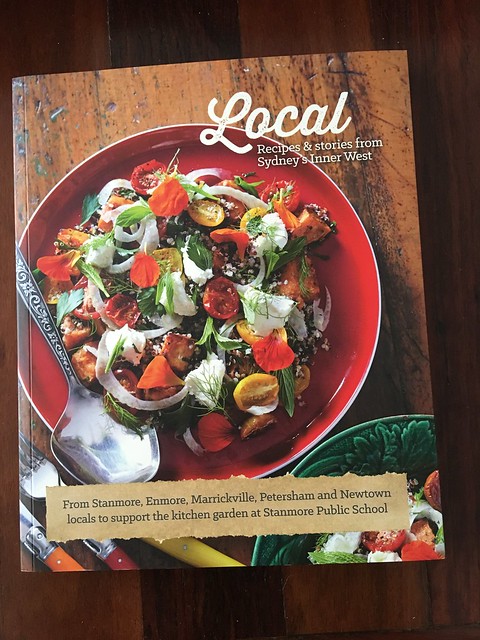
Some thoughts about Local: recipes and stories from Sydney’s Inner West

Local: recipes and stories from Sydney’s Inner WestLocal: recipes and stories from Sydney’s Inner West by Stanmore Public School P&C
My rating: 5 of 5 stars

This is a lovely book from Stanmore Public School.

It has information about the kitchen garden, and the kitchen at the school as well as short suburb histories and statistics for the Marrickville area, and includes photographs of the school.

It also has recipes, and these have photographs accompanying them. The recipes are provided by parents, locals and teachers, and there is a rather lovely 'parents to...' listed for each recipe(other relationships such as mum, grandparent, local are also included). There are recipes from local business owners, and The Henson and Cornersmith are amongst those providing recipes.

This is a genre of books I really enjoy which are local studies meets recipes.

The recipes I have tried have all worked well, and there are many more recipes to explore.

It is published by Stanmore Public School P & C.

This is the first time I have added a record to Goodreads. It would not accept a book which did not have an author. Now I have added one book, there are a couple more I will have to add.

I was also really interested to find that this book was not listed on Trove.

Local studies and foodView all my reviews

Wednesday, April 27, 2016

my thoughts on Playing for time: making art as if the world mattered

Playing for Time: Making Art as if the World MatteredPlaying for Time: Making Art as if the World Mattered by Lucy Neal
My rating: 5 of 5 stars

I really liked this book. It is very much about collaborative, community based art work encouraging people to think about their communities, resilience and sustainability. Local sustainable food was a continuing theme. One of the projects looks at transitioning local practice, with the aim of more people in a particular area growing hops for local beer or growing food in areas around bus stops, with the idea of encouraging foraging. Librarians and libraries were key to many projects as there were strong information elements in some of the art works and projects - "the librarian is in". Reading through it sounded like there were collaborations with makers and craftivists as well. Another theme in the book was moving from bystanders to activists, with art, action and inclusion.

There are many ideas for how libraries could work with their communities, without the book being explicit about their inclusion. There was an excellent council project, called the Remakery, where (obviously) things were remade, including wood, textiles, bikes... This is a an excellent fit with maker spaces, as this is another slant on that, and brings together skills in the community, and through reuse, is good for the environment. Creativity was a key part of the Remakery as well, and it helped skills up people with classes in sewing, carpentry, computer repair.

Many projects would lend themselves to collecting material for local studies, like the wonderfully named 'Happiness bottles', recording happiness, and the diarykeepers project where locals recorded what was happening in their gardens. The Happy museum project manifesto is "exploring how contact with cultural experience can kickstart healthier and happier communities".

There is a lot that is whimsical within the book and a lot which is practical. For many of the projects sufficient information is provided so that others can implement in their community, including hints about partners, costs and so on. It is very much about connecting people to other people and to place. They are projects which connect diverse communities and are inclusive. It is highly illustrated to show the projects with lots of description (so you could make the project happen).

It is not a book to be read quickly. It took me a long time to read, mainly because it is large and heavy, and so was not a commute read for me. It also had lots of ideas to think about, and I will read it again.

I did a search on Trove and this book is held in four libraries in Australia.


View all my reviews

Monday, April 18, 2016

a few comments about Cosplay in Libraries: how to embrace costume play in your library by Ellyssa Kroski

Cosplay in Libraries: How to Embrace Costume Play in Your LibraryCosplay in Libraries: How to Embrace Costume Play in Your Library by Ellyssa Kroski
My rating: 4 of 5 stars

The title describes the contents of this book really well. It is all about how libraries can have events which include cosplay. There are very detailed annotated resources lists, and almost step by step guides for different kinds of event planning (for example 'host a comic or anime con in your library', 'how to host a cosplay contest'). These lists would give a new event planner, or an event planner new to cosplay events, a lot of confidence. The helpful event planning information would be relevant for other events as well.

There are some excellent examples of how some public libraries in the USA have been working with cosplay as events or part of events with detailed information about costs, number of participants, information about the events, and links to sites like the Facebook page for the event. I really like the way information about evaluation is included, and the costs provided by libraries allow other libraries an estimate of what to expect (generally staffing costs are not listed in the budgets provided).

This is also a book which can serve as an excellent introduction to cosplay, and the etiquette, protocols and other considerations. It is also a very interesting read. You might like to think about cosplay for your library.

View all my reviews

Tuesday, January 5, 2016

Review of Warning, the story of Cyclone Tracy

Warning, The Story of Cyclone TracyWarning, The Story of Cyclone Tracy by Sophie Cunningham
My rating: 4 of 5 stars

This book acknowledges the Northern Territory Archives as being key to it being able to be written. This comes through the body of the book as well as the acknowledgements. It also highlights collecting by other organisations, including the recording of oral histories.

This book shows the value of different methods of research, archives, libraries and interviews. While it includes some personal elements from the author (of her memories and experiences), these do not overwhelm the accounts of what happened in Darwin, rather they help to position them. Similarly references to other disasters are used to make specific points about Cyclone Tracey and the aftermath. This book is a reminder of much discrimination, towards indigenous people and women (and while there have been changes, these have not passed).

Good discussion of the effects of climate change is also used as part of this book.

The personal stories of how people experienced the cyclone are very powerful. This was a powerful book to read, the cyclone accounts are vivid, as are the descriptions of the aftermath (including the politics).

This book highlights the importance of collecting current events. What collecting was done post Cyclone Yasi, the widespread rain and hail in April 2015 in NSW and the Christmas Day fires in Victoria 2015? This is important collecting for public libraries for their local studies collections for local research, but also to enable people to draw information from different events together (as was done in this book). The collections available for this writer show the importance of collecting soon after the event (obviously in a sensitive /appropriate/representative/inclusive way) as well as collecting after time has lapsed.

View all my reviews

Tuesday, December 8, 2015

Review of Oral History and Digital Humanities: Voice, Access, and Engagement

Oral History and Digital Humanities: Voice, Access, and EngagementOral History and Digital Humanities: Voice, Access, and Engagement by Douglas A. Boyd
My rating: 5 of 5 stars

I read this book after hearing a talk by Douglas A. Boyd. It is an interesting and detailed exploration of oral history. The chapters are written to show good examples of what is possible and in some instances to show what could have been done better (like not reducing the background sounds). Ideas such as Creative Commons licensing, are included.

The importance of long format oral history is discussed, and that the length of the interview and the detail recorded add value and provide much research potential. Oral history is not about snappy sound bites. The importance of oral history being online, and searchable (through the use of methods such as OHMS) is also covered. That oral history is listened to, is also highlighted. It sounds obvious, but when much access has been via transcript, sometimes that it is a spoken method can be forgotten. There is good coverage of the importance of access to the recordings so it is important for non-digital formats to be digitised, catalogued, indexed and made available for people to research and listen to for other reasons.

"I believe in the primacy of the recording for our professional practice, while fully understanding and acknowledging the role of text to facilitate discovery and access" and looking for "sustainable models to connect archival users to the online primary sources".

It is a book I will have to reread, and keep thinking about the ideas raised in it.


View all my reviews

Wednesday, October 28, 2015

My review of The Invisible Library

The Invisible Library (The Invisible Library #1)The Invisible Library by Genevieve Cogman
My rating: 3 of 5 stars

This is a good solid three stars, and highlights how wide the three star rating is for me.

I enjoyed reading this book.

Maybe it was not good to read it so soon after The Aeronaut's Windlass but that is how my reservations came in at the library.

This book is about a library (or rather The Library) and the collection policy for it which does not appear to be written down anywhere. Okay, that is one interpretation of what is it about, but it is what drives the story forward - how to obtain a very specific book for the collection. As we see how one book is obtained, we hear stories and rumours of other items being obtained in similar or different way.

There are librarians (or actually Librarians - the capitalisation is important) who travel to parallel worlds, collecting near identical editions (mainly of fiction). There are a range of procurement methods, including theft, and this becomes a slightly discredited method through the book. This theft is off putting (and I don't agree with libraries using theft or theft like practices to develop their collections, and yes I know this is a work of fiction).

There is a dragon, stylish dressing, zeppelins, vampires, werewolves, fae and some very interesting action sequences in the steampunk mix. All of the characters can deliver surprises (and I won't mention exactly what they are because of spoilers). There is character development which works well. This also turns out to be yet another political thriller in my accidental year of reading political thrillers.

It is the first in the series and I will be very interested to see what happens next and look forward to reading the next title.


View all my reviews

Thursday, October 15, 2015

My review of A little book of craftivism

A Little Book of CraftivismA Little Book of Craftivism by Sarah Corbett
My rating: 4 of 5 stars

The title sums it up well. The reader is given the background to Sarah Corbett's involvement in craftivism, and that leads into the rest of the book. There are some strategies about how to be most effective in craftivism, and also information about how to cross stitch. There is wit in the strategies as the aim is to engage. There are some very good strategies, many involving action and patience.

This is very much a personal view (but that is kind of the point of this book). I would suggest reading it as a companion piece to Craftivism: The Art of Craft and Activism but it stands alone too. I read it because I had been following the author on social media.

It is an engaging and quick books to read. It is also a book to go away and think about, and to look back at.

View all my reviews

Tuesday, September 1, 2015

My review of Atmosphere of hope

Atmosphere of Hope: Searching for Solutions to the Climate CrisisAtmosphere of Hope: Searching for Solutions to the Climate Crisis by Tim Flannery
My rating: 4 of 5 stars

This is a pacy and engrossing read. There is a story, with tenuous hope, but still with hope. Some possible solutions to help slow climate change are raised. They all require political will as well as dollars to be successful. There are some good examples of lobbying and advocacy. The science is very readable, and there are lots of references to additional resources. This is a book to read, think about and then take action.

I don't often read books as soon as they are released, there are usually good reasons to delay, like an every growing list of reading. I am going to hear Tim Flannery speak tonight, and I thought reading this book before the talk was a good idea.

View all my reviews

Monday, August 24, 2015

My review of Makerspaces in libraries by Theresa Willingham and @jtdeboer

Makerspaces in librariesMakerspaces in libraries by Theresa Willingham
My rating: 4 of 5 stars

This book provides a solid and helpful introduction to a particular interpretation of makerspaces in libraries. It has very good references to the information talked about so that it would be very easy to seek further information.

There are useful checklists of things to consider when planning makerspaces (and often when planning anything) in a library. The importance of bringing staff with you on the ideas are also addressed. The case studies from the USA, Europe and UK provide helpful perspectives, as well as more resources to explore via the links about them. The case studies highlight different approached to running library makerspaces, including whether volunteers or staff are used. There are also some detailed program examples so you could work your way through these in your library or community.

Many libraries have implemented much more diverse makerspaces, and this book does not focus on them, or include them. It also seems to dwell on a perceived dichotomy between makerspaces/fab labs and everything else libraries do, whereas I see them more as a continuum. That said, it is a very useful introduction to library makerspaces, and would help people start to think through strategies for their library.

It is a tough area to be writing in as more examples and interpretations are available all the time. Specific technology is mentioned, so read this book soon. I is a fast read. The authors did a good job with these challenges.

On the book the authors are both listed, so I would like to acknowledge the work of Theresa Willingham and Jeroen de Boer as they are both not mentioned on Goodreads.

View all my reviews

Monday, August 3, 2015

My review of Global megatrends

Global Megatrends: Seven Patterns of Change Shaping Our FutureGlobal Megatrends: Seven Patterns of Change Shaping Our Future by Stefan Hajkowicz
My rating: 5 of 5 stars

This is an excellent book bringing together global trends. It shows there is hope for changes, but that changes have to happen soon, or the outcome will have no hope. Interesting reading this non-fiction when have inadvertently been reading a lot of catastrophic fiction, A helpful contrast. It is a highly readable book. This builds on earlier research done at CSIRO by the author and others. This is acknowledged in this book.

The megatrends are factors to consider when planning, scenarios of possibilities which you can choose to take action on, hopefully seeking positive outcomes for many people. This is a useful books to read for simply thinking about your own life, but it is also very valuable for thinking about change in your workplace and community.

It brings together some persuasive data, and ideas.

To quote from the book
"My philosophy is that wiser choices begin with imagination. We can seldom look at the future and tell someone the best thing to do. But we can explore, describe and imagine. And thereby create a pathway to better decision making."

"The authors observe that reduced death rate achieved by volunteering was almost as effective as other preventative health measures such as topping smoking"

"The future we create tomorrow hinges on the decisions and actions we take today. What we want is for people to make rational decisions and wide choices. We want people to understand change, set objectives and choose wisely. Moments of freefall happen to you, your company, your society and the world. That's assured. It's not whether change will happen, but when and how you respond."

Reading this book also, yet again, reinforced the huge value of the research done by CSIRO, and the problems caused, or not solved, by the continued cuts to this organisation.

View all my reviews