Showing posts with label #glamblogweekly. Show all posts

Tuesday, January 9, 2018

A few thoughts on the book Tinkering: Australians reinvent DIY culture by Katherine Wilson

Tinkering: Australians Reinvent DIY CultureTinkering: Australians Reinvent DIY Culture by Katherine Wilson
My rating: 4 of 5 stars

This book explores the concept of tinkering in Australia. It is based on interviews with several tinkerers (mainly from Victoria) and uses aspects of ethnography as the methodology for this research. This interesting book is based on the doctoral research by the author.

There are useful ideas in this book for libraries which have maker spaces or other connections to makers and tinkerers to consider however, libraries are almost invisible in the work. There could be another interesting research project looking at the connection between libraries and making and tinkering.

The discussion of tinkering in this book includes a wide range of formats including electronics, mechanical, building, research, photography, and jam making. Mending is raised as a tinkering area, but it is acknowledged that more research needs to be done into this area.

There are useful perspectives of failure and mistakes presented through this work. Block, one of the people interviewed for the research states, ‘I make mistakes all the time, that’s how you learn about things and get more experienced. You have to think, and you have to be patient’. Hondo, another interviewee states that you ‘never know if what you imagine will turn out’.

The author writes that when ‘policy makers and bureaucrats make decisions about cultural spaces like Men’s Sheds, Hackerspaces, community gardens, manual education and innovation programs, they need to understand that their magic force lives in quests, stories, senses, skills and the plotting of self in he continuity of experience...For all its senseless and supernatural overtones, magic is an important way to understand the everyday transformative, spellbinding power that pulses through Australia’s sheds, paddocks, kitchens, backyards and workshops’. p83. This idea of forces of magic is an interesting description to use.

While there is no index, there is a useful and detailed list of select references.

View all my reviews

Friday, September 29, 2017

thinking about the ideas of safe in libraries for #glamblogclub

As Terry Pratchett wrote in Soul Music
The Library didn't only contain magical books, the ones which are chained to their shelves and are very dangerous. It also contained perfectly ordinary books, printed on commonplace paper in mundane ink. It would be a mistake to think that they weren't also dangerous, just because reading them didn't make fireworks go off in the sky. Reading them sometimes did the more dangerous trick of making fireworks go off in the privacy of the reader's brain. This quote demonstrates the safety to explore a wide range of ideas in libraries.

Thinking about this post and the idea of libraries as safe places has also made me think back to my post about silence as some of those who are silent/silenced in the library may also not feel that that library is safe, or that it saves their stories for the community. 

There has been a lot of discussion about libraries being neutral places (for example this and this). I am not convinced that libraries have ever really been neutral, as often it is those who have not been excluded who are writing about the neutrality of libraries.The discussion of neutrality is not always accompanied by discussion of libraries as safe places.  Sometimes it is not possible for the library to be both safe and neutral, and safe should not be sacrificed.  Safe was sacrificed for decades in libraries in the south in the USA (Not Free, Not for All: Public Libraries in the Age of Jim Crow - is an amazing and disturbing book to read) although they also may not have said they were neutral.  This is true in other places around the world where there have been (or maybe still are) restrictions on who can use the space, or the library intimidates (by the building, by the staff...).  Libraries should be safe places to go to.

They should be safe places to explore ideas, without risk of harm.  Libraries should also make sure their client data is safe, and that as much other data as possible is open for people to use.  Digitising and collecting digital content can be ways to make information available (but often isn't as people choose copyright over open creative commons licenses). If your organisation owns the copyright on something, they can choose to make it widely available while it is still in copyright.

Maker spaces are a great way for people to explore ideas and to experiment (and yet they need to safe so that people are not injured). Libraries should be safe for staff (think work health safety, not bullied, support from managers) and all who use them (in the library and online).

The tweet, below, shows libraries as a safe place to explore literacy.


Read more about Dr Carla Hayden, and the importance of libraries as safe places (repositories). There continues to be much destruction of libraries, both by war and by neglect (including inadequate funding).

Neil Gaiman says "Libraries really are the gates to the future" (go and read the whole article here) Libraries should be a safe place to explore a wide range of ideas, and this includes through collections, services and programs, and this can lead to a very wide range of outcomes.  There is much more to ponder on this idea, but I am almost out of September to write it in. 

Tuesday, September 12, 2017

#rakowinspired from @corningmuseum

The Corning Museum of Glass, is an amazing museum. They are continue to profile the library at the museum, the Rakow Research Library. Recently on the museum Instagram account, they have been encouraging people to share their #rakowinspired work. This is a lovely way to share work inspired by the library at the museum (which is why I did a storify of it).

Monday, September 11, 2017

#thegreatmnknittogether and local studies potential

Here is a storify of the #thegreatmnknittogether which was planned and implemented for the recent Minnesota State Fair. It is a wonderful tale of collaboration and hard work.  The photographs are one way to record the state fair. The items knitted also demonstrate social history, and perceptions in the community. I am hoping the local public library is collecting some of this information, as it would be an interesting inclusion in local studies.

The first video in the storify has more information about this.

Monday, August 28, 2017

an example on Instagram from Phoenix Public Library

This repost on Instagram from Phoenix Public Library
is a lovely promotion of reading widely.  There is a mosaic of titles to explore, and it is a great photograph for readers' advisory.

Have at look at your library Instagram feed - does it reflect the diversity of your community?  If not what steps are you taking to make sure that it does?


Monday, August 21, 2017

twisted preservation

Last year I heard a talk by Frank Vagnone. I found out about it from an email update from Museums and Galleries NSW. The talk was looking at historic house museums, and the ideas were of relevance to many other sorts of organisations as well.

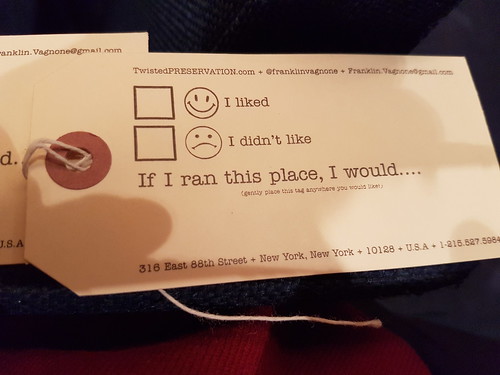
Label for Twisted preservation


The label photographed shows a feedback mechanism which was used to explore how people saw historic houses. It was a way to learn about what people liked, did not like and their ideas for change. This is a way to encourage people to suggest ideas.

For more ideas go and read Anarchist's Guide to Historic House Museums by Franklin D. Vagnone, Deborah E. Ryan.  It is a really interesting book with some great ideas about looking at history (and the need to be inclusive). I am thinking it is time for me to read it again too.

Wednesday, August 16, 2017

silence for #glamblogclub

There are a lot of ways this can be explored.  I thought about the ideas of the Silence and Silence in the library. Since starting this post I have read Jane Cowell's piece on silence which I enjoyed.

I am interested in who in your community is silenced:
  • because they are not using the library
  • because their history and stories are not being collected in local studies
  • because people like them are not shown in the collection
This will vary from library type to library type.  My comments are mainly about public libraries, but are relevant for other libraries too.

Who is the library silencing?

With membership data it is possible to see, at least roughly, who is using the library.  For public libraries membership data could include postcodes and location names.  It should be possible to work out if there are geographic areas where residents are not connecting to the library.  There can be many reasons for this, and each library will need to investigate as they can include:
  • not knowing what the library offers
  • knowing what the library offers and not thinking it is relevant
  • hours which make it hard to access the library
  • slow download speeds so that even if you can get to the library to join borrowing econtent is not feasible
  • the programs and services are not seen as relevant 
Are the programs targeting a narrow range of the community? When you try something different and have lower numbers, do you interpret this as a fail, and decide to never try something different again? 

Is how the collection structured silencing people?  In Australia we have not had the same high profile approach as the We need diverse books in the USA.  We also need diverse books, so that everyone is seeing someone like them in the collection, in fiction and non-fiction, but also so that we are all seeing a wider world.  This means working a bit harder on collection development. Also keeping in mind every community needs this diversity, even if the same diversity is not visible on the street (because you don't know who you are silencing).

Local studies as a special area of the collection also needs to not silence people.  Only collecting people of certain backgrounds is silencing everyone else.  As well as silencing them, you are making them invisible as well

We all need to change our ways.

Monday, July 10, 2017

A few thoughts on Servant of the crown (and there is a library connection)

Servant of the Crown (The Crown of Tremontane #1)Servant of the Crown by Melissa McShane
My rating: 3 of 5 stars

I read this book because I wanted to see how a royal librarian was depicted in fiction. This is a political thriller and romance with a mistreated library in the middle. There are cataloguing problems (the single volume listing is stolen), supply problems for cataloguing cards (and creative solutions for substitutes), there are humidity issues which are destroying the collection, and on top of that there is theft and corruption. There also have been no new collection items acquired for over two years. This is not a problem of supply as there is a local publishing boom, but one of how new materials are not always welcomed in a heritage library. In this context since this library is similar to a legal deposit library a broader acquisition approach is needed. Issues of appropriate training for librarians are raised and that is a problem which is not effectively resolved.

View all my reviews

Monday, July 3, 2017

I will be participating in #glamblogweekly or #libblogweekly or whatever the hashtag is

I made it half way through #blogjune and then did not blog for the rest of the month. I really enjoyed reading the blog posts from others.

At the end of the month I read this post by Kathryn (so make sure you head over and read her post now).

I am viewing #glamblogweekly, #libblogweekly  (or whatever the hashtag ends up being) as an encouragement to blog, and work on writing and communication skills, rather than a threat.  I have lots of deadlines in the rest of my life which have no flexibility, so the choice and encouragement of blogging once a week will be viewed as a choice and an encouragement.

I have set up my calendar alerts, to remind me to write posts. I am not going to guarantee to write a post every week - since I did not manage every day of June this year.  Some weeks will be photographs with little writing.  I look forward to seeing what blog posts are written by others participating in this.

Happy blogging.