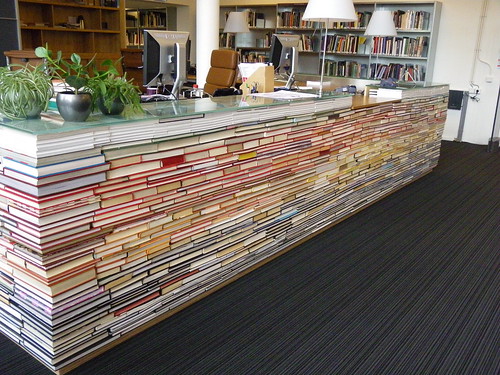
I tripped across a Storify of photographs I tweeted from a tour of the Library at the Dock, in Melbourne. The tour was after the Library stars seminar in 2014, and as I was there for work, I tweeted the photographs - so I could share what I was seeing. I put photographs on my Flickr account when I take them in my own time.
If I am there for work they may go on one of the official work social media accounts, or if they aren't going to go there they are like these in the Storify, reporting on a seminar I went to (and not into my Flickr account).
Think about how you share the photographs you take. Are you happy for people to re-use them? If so, make them easy to re-use.
This post came to my attention (thanks to an rss feed incase of scary things being said) as did this one, this one, this one, and this one. These last photographs are from my Flickr stream (and so are taken in my own time).
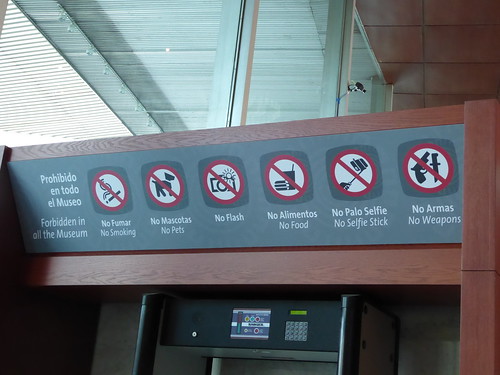
These days I assume that it is fine to take photographs in museums, galleries, archives and libraries unless I see a sign saying I can't. If I see a sign saying I can't take pictures I wonder why I can't photograph. As long as flash options are turned off photography is safe for the items. As long as people are considerate, photography is not disruptive to others - and it should not be disruptive to others. I am not a fan of selfie sticks, but other than the use of these, mostly people are considerate when photographing in galleries.
In the Metropolitan Museum of Art they allowed photography, except of four paintings by Van Gogh. It was a special exhibition, but not their only special exhibition. There were lots of people looking at these four flower paintings, but there were lots of people throughout the museum. I was wondering if it was to do with merchandising, but many of their items have copies for sale. I do not know the reason, nor was asking possible. It did not interfere with my enjoyment of these paintings, but it made me think about why photography seemed okay elsewhere in the museum.
If you stop people taking photographs, it can be helpful to explain why. This can be part of the educative process.
Photographing collection items, or spaces is different to photographing people using those spaces.
Cambridge Public Library, MA required any photography to be have paperwork filled in, carried, and shown to all staff who asked. When I visited their central library I was aware of this requirement. I was impressed that every staff member who saw me with my camera (and I was trying to be unobtrusive), asked to see the paper work (or commented on the need for it until I showed it to them). The consistency was impressive. I do not photograph people in libraries (except for occasional back or partial views). Sometimes it means that parts of libraries can not be photographed - so be it. I don't want to be disruptive to someone's use of the space - not have to engage in a long discussion about permission.
If you ban photographs in certain areas, it can be helpful to educate your community as to why they are not permitted.
I find it really interesting to see how easy it is to share things from within different buildings, particularly cultural institutions. For example people are (generally) not going to question me taking photographs of sculptures and other art works if they are outside. Yet often if I wanted to photograph a work by the same artist inside a building I would be stopped, or there would have been a lot of signs to tell me to not even think about taking a photograph. I understand that use of flash can cause deterioration, however, I know how to turn my flash off, but other than that it seems to be saying that if an art work is inside it is more special (and so should not be photographed and shared through social media or in other ways) than an art work outside.
I had a very different experience when I visited the 7th Asia Pacific Triennial of Contemporary Art (APT7) in Brisbane in early March. It was an amazing exhibition with many very exciting artists. The gallery had free wifi, which was clearly advertised. They provided links to access some art works like this recipe book (link is at end of this page), which could be downloaded using the gallery wifi.
I visited when some school students were there, and a high percentage of them were photographing and videoing the art works. Gallery staff were watching - so it was not some secret thing people should not be doing. These were amazing current art works, many of which should be around for decades, while some were temporary. I thought this open approach to photography was impressive.
It is important that photography in public spaces does not interfere with other people's use of the space, for example, use of tripods, or people being really slow, but it can be less intrusive that people looking at the exhibition (sometimes).
With photography becoming easier, and less obvious (particularly with smartphones) we need to educate people about photography in exhibitions, and if they really should not be taking photographs, give a clear and easy to understand reason why (and not treat them like criminals).
It was also impressive because some of the art works were around the 20 year archive of the exhibition.
It was a lovely way to profile archives, but also to show a different way they can be viewed - as art works themselves.
I also thought it was a great way to encourage people thinking about the importance of archives, and in making archives literally more visible.
The library was also featured in the exhibition with this dramatic entrance way.
This was a great way to profile the library, but the connection to the exhibition worked really well - as well as looking impressive. It was great to walk through the ripped wall into the red space, and then into the library. You could also see the library through a glass wall into the gallery - so even when this exhibition is not on, it is not hidden away, but is an obvious part of the gallery space.
You can see some of my photographs of the spaces below.